
🌿 Deck Tech: Meren of Clan Nel Toth — Golgari Graveyard Value (For New & Casual Players)
If you’ve ever wanted to squeeze every last use out of your creatures — even after they’ve died — Golgari (Black-Green) might be your perfect home in Commander. Golgari decks thrive on recycling resources, generating value from death triggers, and growing stronger the longer a game goes on. And no Commander embodies this philosophy better than Meren of Clan Nel Toth.
This article offers a deeper, more detailed look at the Golgari Graveyard Value archetype, specifically for newer and more casual Commander players. Whether you’re learning how to use your graveyard as an engine or just want a reliable, fun deck on a budget, this guide will walk you through everything you need.
🧬 What Makes Golgari Graveyard Value Special?
At its heart, a Golgari value deck is a machine built on resilience. Instead of worrying when your creatures die, you welcome it. Death is fuel: it grows your Commander’s experience counters, fills your graveyard with threats ready to return, and triggers a chain reaction of abilities that give you card draw, removal, tokens, or mana.
Your graveyard becomes a second hand — one you can access again and again throughout the game. This makes Golgari incredibly forgiving, especially for players still learning how to pace a Commander match.
🌱 Meren of Clan Nel Toth — The Perfect Beginner Commander
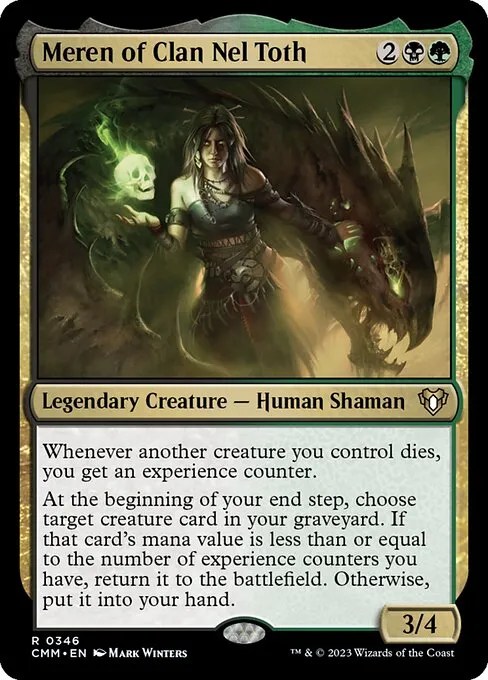
Meren is one of the most intuitive and rewarding recursion Commanders ever printed. At four mana, she enters play early and immediately starts turning your creature deaths into long-term advantage.
Her experience counter mechanic is simple to understand: every time one of your creatures dies, you gain a counter. At your end step, Meren lets you return a creature from your graveyard either to your hand or to the battlefield, depending on how many experience counters you’ve collected.
This scaling effect means Meren naturally thrives in longer, more casual games. Even if opponents remove her, she returns cheaply and picks up where she left off. New players appreciate how she smooths out mistakes — mis-sequenced plays or lost creatures become opportunities, not setbacks.
💀 How the Deck Operates: Ramp, Sacrifice, Recursion
A successful Meren deck rests on three pillars: ramp, sacrifice outlets, and recursion tools.
In the early turns, you focus on developing your mana and preparing your graveyard. Creatures like Satyr Wayfinder, Sakura-Tribe Elder, or Stitcher’s Supplier help you do both at once. Cards like Cultivate and Kodama’s Reach keep you from falling behind on mana while also thinning your deck.
Once Meren enters the battlefield, the midgame becomes a loop of using and reusing small value creatures. Natural sacrifice outlets such as Viscera Seer, Evolutionary Leap, or Deadly Dispute allow you to control when your creatures die — giving you experience counters while triggering any “dies” abilities along the way.
Recursion pieces tie the whole strategy together. Cards like Eternal Witness, Victimize, Journey to Eternity, and even budget powerhouses like Deadbridge Chant make sure that losing creatures is never a real problem. As the game goes on, Meren begins bringing back bigger and more impactful threats, turning every turn into a swing in your favor.
🧩 Game Flow: Early, Mid, and Late Game
During the early game, your focus is on setup. You’ll play small creatures that replace themselves with lands or cards while quietly seeding your graveyard. Don’t be afraid to block aggressively — every death grows your experience counter total.
By the midgame, you’ll have access to Meren and begin looping powerful utility creatures. Removing troublesome permanents with Reclamation Sage, forcing sacrifices with Fleshbag Marauder, or repeatedly fogging attacks with Spore Frog all become reliable lines of play.
The late game is where Golgari truly shines. Big payoffs like Living Death or Izoni, Thousand-Eyed can single-handedly flip a board state. Finishers like Syr Konrad, the Grim slowly drain the entire table as you recur creatures, mill cards, or resolve mass reanimation spells. The best part? Even after wiping the board, you’ll always be the first player able to rebuild.
🪵 Budget-Friendly Build Philosophy
A casual Meren deck on a budget doesn’t need expensive staples to run smoothly. Most of your strongest cards — self-mill creatures, sacrifice outlets, and recursion spells — are inexpensive. You’ll want around 30–35 creatures, leaning heavily into utility and value. Focus on cards that offer benefits when they enter or leave the battlefield.
Your noncreature spells should support the main plan: efficient removal, reliable ramp, and at least two or three strong recursion engines. Your land base can stay simple, using inexpensive dual lands and a handful of useful utility lands.
This approach gives you a durable, flexible deck that plays a satisfying grindy game without ever feeling underpowered.
⚙️ Pitfalls to Avoid as a New Meren Player
It’s easy to overfill your graveyard too fast. Milling twenty or thirty cards early can accidentally dump key pieces you aren’t ready to reanimate yet. Instead, aim for gradual accumulation — your graveyard grows naturally as the game proceeds.
Another common mistake is running too few sacrifice outlets. Meren’s ability hinges on your creatures dying when you need them to, not when your opponents allow it. Sacrifice outlets are your deck’s engine — treat them as high-priority.
Finally, never underestimate the importance of ramp. Your recursion spells, larger creatures, and value engines all require lots of mana to deploy repeatedly. More ramp means more options.
🪄 Example Decklist: Meren of Clan Nel Toth (Under $75 Budget)
Below is a complete decklist built with new players in mind. It emphasizes smooth gameplay, consistent value, and fun graveyard interactions.
🔗 View the Deck on Moxfield
Moxfield Link:
https://moxfield.com/decks/7JIqrjME3kKsmBiVGX3zKw
📘 Full Decklist (Text Version)
Commander
Meren of Clan Nel Toth
Creatures
Stitcher’s Supplier
Satyr Wayfinder
Elvish Visionary
Golgari Thug
Golgari Findbroker
Eternal Witness
Reclamation Sage
Yavimaya Elder
Sakura-Tribe Elder
Wood Elves
Llanowar Visionary
Skull Prophet
Plaguecrafter
Fleshbag Marauder
Merciless Executioner
Caustic Caterpillar
Syr Konrad, the Grim
Viscera Seer
Blood Artist
Zulaport Cutthroat
Spore Frog
Mycoloth
Izoni, Thousand-Eyed
Gravebreaker Lamia
Sidisi, Undead Vizier
Kokusho, the Evening Star
Apprentice Necromancer
Pawn of Ulamog
Carrier Thrall
Golgari Grave-Troll
Victimize (creature version)
Instants
Putrefy
Beast Within
Golgari Charm
Malakir Rebirth
Heroic Intervention
Deadly Dispute
Sorceries
Cultivate
Kodama’s Reach
Mulch
Grisly Salvage
Living Death
Buried Alive
Victimize
Casualties of War
Artifacts
Skullclamp
Golgari Signet
Commander’s Sphere
Arcane Signet
Mind Stone
Enchantments
Journey to Eternity
Deadbridge Chant
Oversold Cemetery
Poison-Tip Archer
Evolutionary Leap
Bastion of Remembrance
Lands (38)
Command Tower
Golgari Rot Farm
Jungle Hollow
Blighted Woodland
Myriad Landscape
Mortuary Mire
Grim Backwoods
Bojuka Bog
10 Swamp
10 Forest
Llanowar Wastes
Tainted Wood
Woodland Cemetery
Evolving Wilds
Terramorphic Expanse
Temple of Malady
Oran-Rief, the Vastwood
Westvale Abbey
💬 Final Thoughts
Meren of Clan Nel Toth is one of the most natural teachers of Commander fundamentals: timing, value, sequencing, and resilience. A Golgari Graveyard Value deck doesn’t win through brute force — it wins by outlasting every opponent and turning every loss into growth.
If you’re a newer player looking for a deck that grows with you, teaches you good habits, and plays a memorable game every time, Golgari is the garden you want to tend.
What’s your favorite Golgari card or graveyard combo?
Share it in the comments — your deck might appear in a future Commander ProTips feature!

 CommanderProTips
Leave a comment